
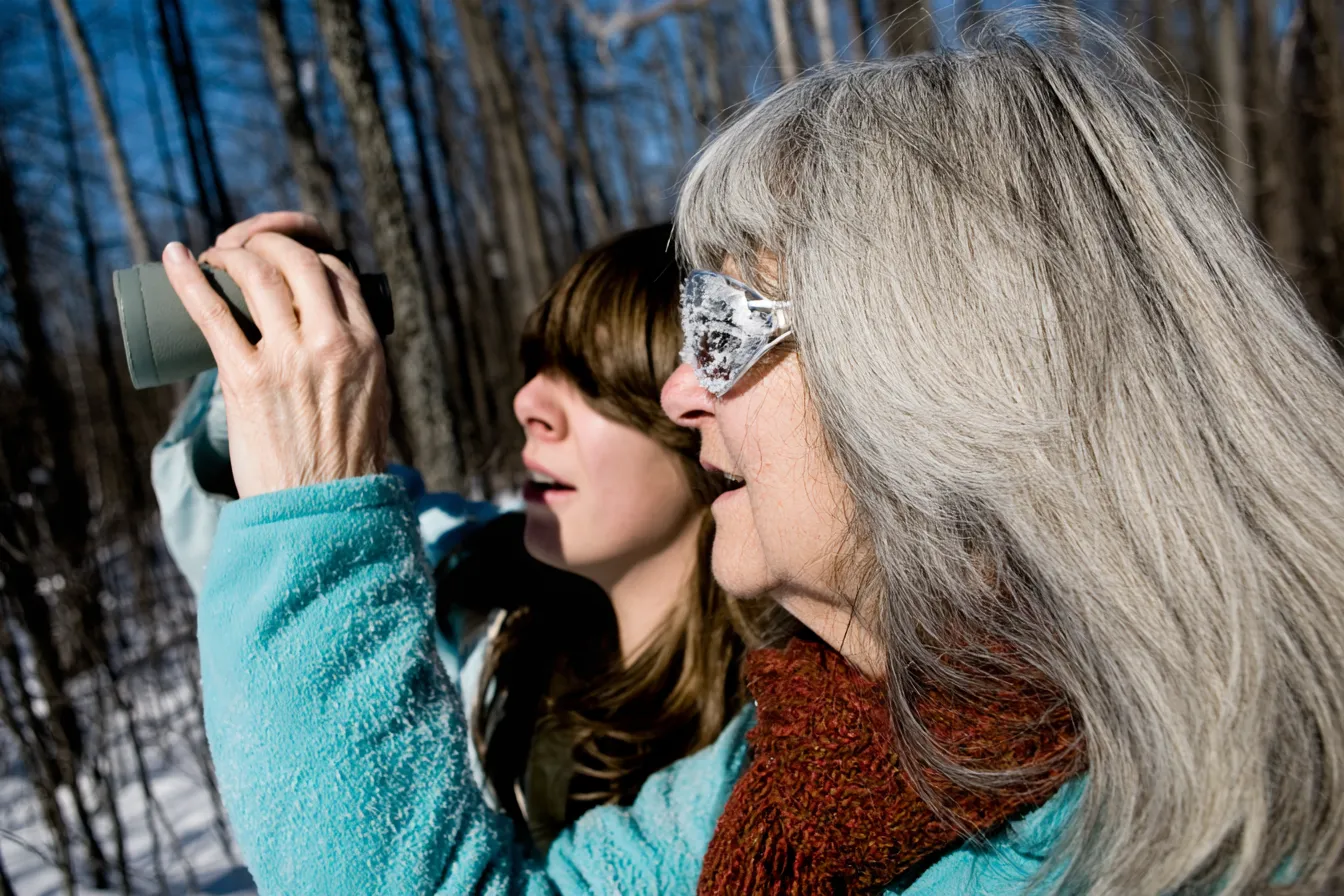
Grace has lived near Alpena for sixty-nine years. Her grandson Noah thinks winter is mostly something you survive until baseball season.
One Saturday, she takes him birdwatching.
Noah has never understood why his grandmother gets excited about a bird sitting on a branch. Birds are everywhere. He would rather play basketball, though the court has been buried beneath snow for two weeks. Grace collects him on Saturday in her old car, a canvas bag of binoculars and folded checklists on the back seat, and a thermos of cocoa beside two Brighter Cup tumblers, one coral and one red. She doesn’t demand that he be enthusiastic. She just asks him to wear the heavier boots. They stop first at Cabin Creek Coffee downtown, where she buys him a muffin he pretends not to want and eats in two bites. North of town they take the Duck Lake Trails through the Besser Natural Area, keeping to the path and well back from any shoreline ice. The morning feels pale and almost soundless. Grace stops to look at a flock moving between trees. Noah scans the branches and sees nothing. She tells him not to stare at where the bird was, but to wait for the next movement. He thinks this is suspiciously philosophical for eight in the morning.
The birdwatching bag contains several items Noah initially considers excessive: a spare pair of gloves, tissues, a pencil, a small notebook and a folded paper map. Grace says paper works even when a battery dies. Noah says this argument has been made before. Still, he begins to enjoy looking for shapes in the branches rather than checking his screen. He notices that the birds are not all doing the same thing. Some seem to travel in small restless groups; others pause, call, and wait. Grace points out how to observe without disturbing them or approaching nests. Noah records small descriptive details in addition to names, one line for a bird that looks ‘like a very serious person in a tiny coat.' Grace asks whether she can borrow that description. He agrees, pleased she took him seriously. For the first time he wonders what else she knows that nobody has bothered to ask her about.
Grace learned the names of birds from her father, who worked long hours but always found time on Sundays to take her outside. He could identify a cardinal by the sound of its call, she tells Noah, though she suspects he occasionally made up names just to make her laugh. She carries a field guide with corners softened from decades of use. Noah asks whether there is an app that does the same thing. Of course there is, she says, but then they would be looking at a screen instead of the bird. He concedes the point for exactly thirty seconds. After the chickadee appears, he becomes a careful observer, noticing small movements, calling out colors and comparing his guesses to pictures. He records a list in his phone anyway, and Grace doesn’t object. At lunch they take a booth at the Court Yard Restaurant as a little snow begins to drift down outside. Noah asks if his great-grandfather would have liked this place. Grace says he would have liked any place Noah wanted to look closely. That evening he sends her a photograph of the checklist. His handwriting is terrible, but she prints it out.
The next weekend, Noah calls and asks if she wants to go out again.
Grace pretends to check her calendar.
She’s been looking forward to his call all week.
Setting artwork is illustrative; it does not depict the story’s cast or document an event.